
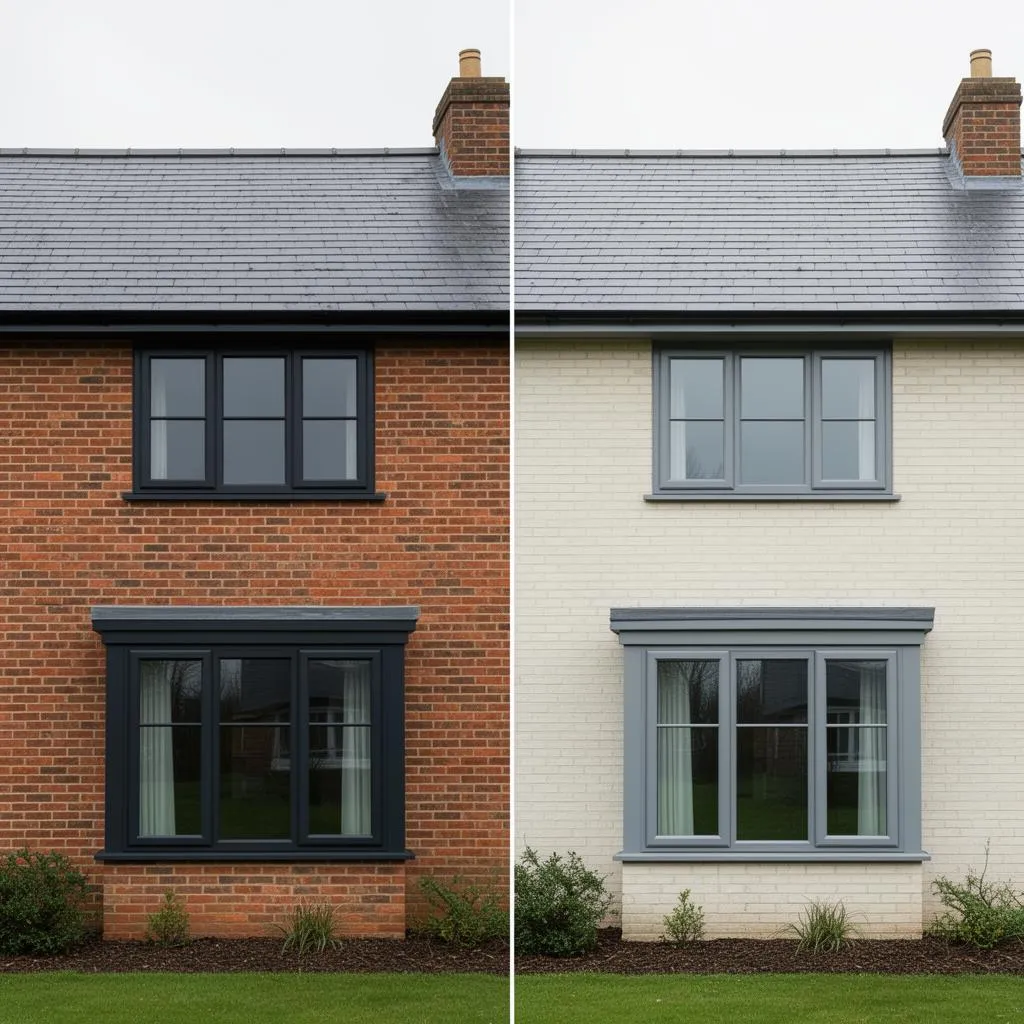
Walk down any street in Birmingham or the West Midlands today and you'll see two colours dominating the windows on freshly updated homes: Anthracite Grey and Agate Grey. They're the two most popular uPVC window colours in the UK in 2026, and they're often presented as interchangeable — two shades of grey, take your pick.
They aren't interchangeable. They look different, they suit different homes, they age differently, and choosing the wrong one is the kind of mistake you live with for ten years.
Here's what you actually need to know before you commit.
Quick Answer
Choose Anthracite Grey (RAL 7016) if you want a bold, modern, statement finish that contrasts strongly with light brick or render. It's the most popular choice in the UK for a reason — it works on almost any modern home and creates a dramatic, contemporary look.
Choose Agate Grey (RAL 7038) if you want a softer, lighter update that looks contemporary without being heavy. It works better on period properties, lighter-coloured brickwork, and homes where a deep dark grey would feel too dominant.
If you're stuck between the two, the deciding factor is almost always the colour of your brickwork. Read on for the detail.
The Technical Difference
Both colours come from the RAL Classic system, which is the standard colour reference used across European architectural coatings.
Anthracite Grey is RAL 7016. It's a very dark, near-black grey with subtle blue undertones depending on the light. Its Light Reflectance Value (LRV) sits in the single digits — meaning it absorbs almost all the light that hits it and reads as almost black from a distance.
Agate Grey is RAL 7038. It's a mid-toned, neutral grey with warmer undertones. Its LRV is significantly higher (roughly four to five times more reflective than Anthracite), which means it reads as a clearly identifiable grey rather than reading as "dark" or "black".
Both colours are available in any professional uPVC window spraying project. Both use the same 2K polyurethane coatings, the same primers, the same application process. The only thing that changes is the pigment in the topcoat.
How They Actually Look in Real Life
This is where most online colour comparisons fall down. RAL chips show you the colour in isolation, under perfect lighting, on a flat sample. That's not how a window frame looks on a real house.
Anthracite Grey in real life looks dramatic and architectural. On a bright sunny day it reads as a deep charcoal grey. On an overcast day or in shadow it reads as black. The visual contrast against white render or light brick is striking — it draws the eye sharply to every window opening, creating strong rhythm across a façade.
The trade-off: it can feel heavy on smaller windows, narrow frames or properties with lots of small panes. On the wrong house it can look like the windows have been blacked out.
Agate Grey in real life looks softer and more architectural-neutral. It doesn't read as "dark" — it reads as "grey". Frames remain visible as a colour rather than dissolving into shadow, which keeps the proportion of the window relative to the wall feeling balanced.
The trade-off: it has less wow factor. If you want neighbours stopping to comment, Anthracite delivers that more reliably. Agate is the more confident, less attention-seeking choice.
Not Sure Which Grey Is Right?
We bring physical RAL colour samples to every free quote. See the colour against your actual brickwork before you commit.
Which Suits Which Home
The single biggest factor is the colour of your brickwork or render. Here's how each pairs:
Red Brick (Victorian Terraces, Edwardian Semis, 1930s Housing)
Anthracite wins. The high contrast between deep red brick and near-black frames is the most popular combination in the UK for a reason — it's the look that defined the kerb appeal trend of the past five years. Agate also works on red brick but feels less decisive.
Light Buff or Yellow Brick (1960s/70s Estates, Much of the West Midlands)
Either works, lean Agate. Anthracite can feel oppressive against pale brickwork — the contrast is too strong and the windows can look like dark holes. Agate sits more comfortably and updates the property without overwhelming it.
White or Cream Render (Modern New Builds, Rendered Semis)
Anthracite wins by a mile. The crisp white-on-near-black contrast is the textbook contemporary look. Agate against white render can look washed out and undecided.
Stone or Pale Grey Façades (Period Properties, Conservation Areas)
Agate wins. Anthracite is too aggressive for stone — it fights with the natural variation in the masonry. Agate complements it.
Mixed Brick with Multiple Tones
Either works. Pick based on which dominant tone you want to draw out. If your brick has darker browns and reds, Anthracite emphasises them. If your brick has lighter buffs and creams, Agate harmonises with them.
Mock Tudor or Timber-Framed Homes
Anthracite, by quite a margin. The dark frame matches the dark timber detailing and reads as deliberate. Agate looks accidental against black timber.
How They Age
Both colours, professionally sprayed in 2K polyurethane, will hold their finish for 10 years or more without chalking, fading or peeling. That's the headline answer.
The honest, slightly more nuanced answer is that darker colours show fade earlier than lighter ones — not because the coating is worse, but because the human eye notices a 5% loss of pigment more easily on a near-black surface than on a mid-grey one.
In practical terms:
- Anthracite stays looking good for the full guarantee period, but if you compare it side by side with a freshly sprayed Anthracite frame at year 9, you'll see a small difference in depth.
- Agate is more forgiving. Small amounts of fade are barely visible, and the colour holds its character for longer.
Neither colour streaks, peels or flakes when properly applied. Both clean up with a damp cloth and mild detergent. Both are guaranteed for 10 years.
Popularity in 2026
Anthracite Grey has been the UK's number one uPVC colour for the past five years, and it remains the most-requested colour at Spray Genius in 2026. We spray more Anthracite than every other colour combined.
Agate Grey is the fastest-growing alternative. Five years ago we sprayed almost no Agate. Today it's the second-most-requested colour, and it's gaining ground every quarter — particularly on period properties and lighter brick homes where homeowners want a contemporary update without going to a full near-black finish.
The trend is genuine: the dominance of "as dark as possible" is slowly giving way to softer mid-greys. Whether that becomes a long-term shift or whether Anthracite reclaims the top spot remains to be seen.
For most homeowners, the practical takeaway is simpler: both colours are firmly mainstream, neither will look dated in five years, and both add to kerb appeal rather than detracting from it.
Cost
Both colours cost exactly the same to spray. There's no premium for either. Custom RAL colour matching, including both 7016 and 7038, is included in our standard pricing — you're not paying more for the popular options.
Full pricing for window spraying, including realistic ranges by property size, is in our complete uPVC spraying cost guide for 2026.
Our Verdict
If you have red brick or white render and you want the boldest possible update: Anthracite Grey. It's the most popular colour in the UK for a reason, and on the right house it's unbeatable.
If you have pale brick, stone, or a period property where Anthracite would feel too heavy: Agate Grey. Softer, more confident, and more forgiving over time.
If you're genuinely undecided, ask for physical sample swatches before committing. Both colours look different in person than they do on a screen, and seeing them held up against your actual brickwork in your actual light is the only way to know for certain. We bring physical RAL samples to every free quote in Birmingham and the West Midlands.
Frequently Asked Questions
Is Anthracite Grey the Same as Anthrazitgrau or RAL 7016?
Yes. All three names refer to the same colour. RAL 7016 is the official designation; Anthracite Grey is the English name; Anthrazitgrau is the original German name.
Will Anthracite Grey Make My House Look Smaller?
On most properties, no — but on small terraced houses with lots of small window panes it can make the windows recede visually, which some people read as "smaller". Agate Grey is the safer choice for very small properties.
Do Dark uPVC Frames Warp in Summer Heat?
Modern uPVC profiles are engineered to handle dark colours without warping, and our 2K polyurethane coatings include UV stabilisers specifically to prevent heat absorption issues. We've sprayed thousands of frames in dark colours with no warping problems.
Can I Have My Windows Sprayed Anthracite if My Doors Are Already a Different Colour?
Yes — and we usually recommend spraying both at the same time so they match. Mixing colours across windows and doors is the most common reason customers come back six months later asking us to re-do half the job.
What's the Most Popular Alternative to Grey Altogether?
Chartwell Green (sage), Black (RAL 9005), and Cream/Ivory shades are the three most-requested non-grey alternatives in 2026. Chartwell Green is particularly popular for period properties and conservation areas.